
Introduction
As artificial intelligence systems become increasingly sophisticated, they encounter an unavoidable challenge: the exponential growth of knowledge and reasoning. Modern AI models process billions of interactions, analyze interpretations of interpretations, and generate layers of meta-analysis that expand endlessly.
No matter the scale of storage or server capacity, this recursive explosion eventually creates a bottleneck: AI risks reaching a saturation point where memory, storage, and bandwidth cannot keep up with its accumulated reasoning.
Adaptive Compressed Pattern Memory (A.C.P.M) is introduced as a solution — a method to store essential human-related patterns while minimizing resource consumption.
---
What is A.C.P.M?
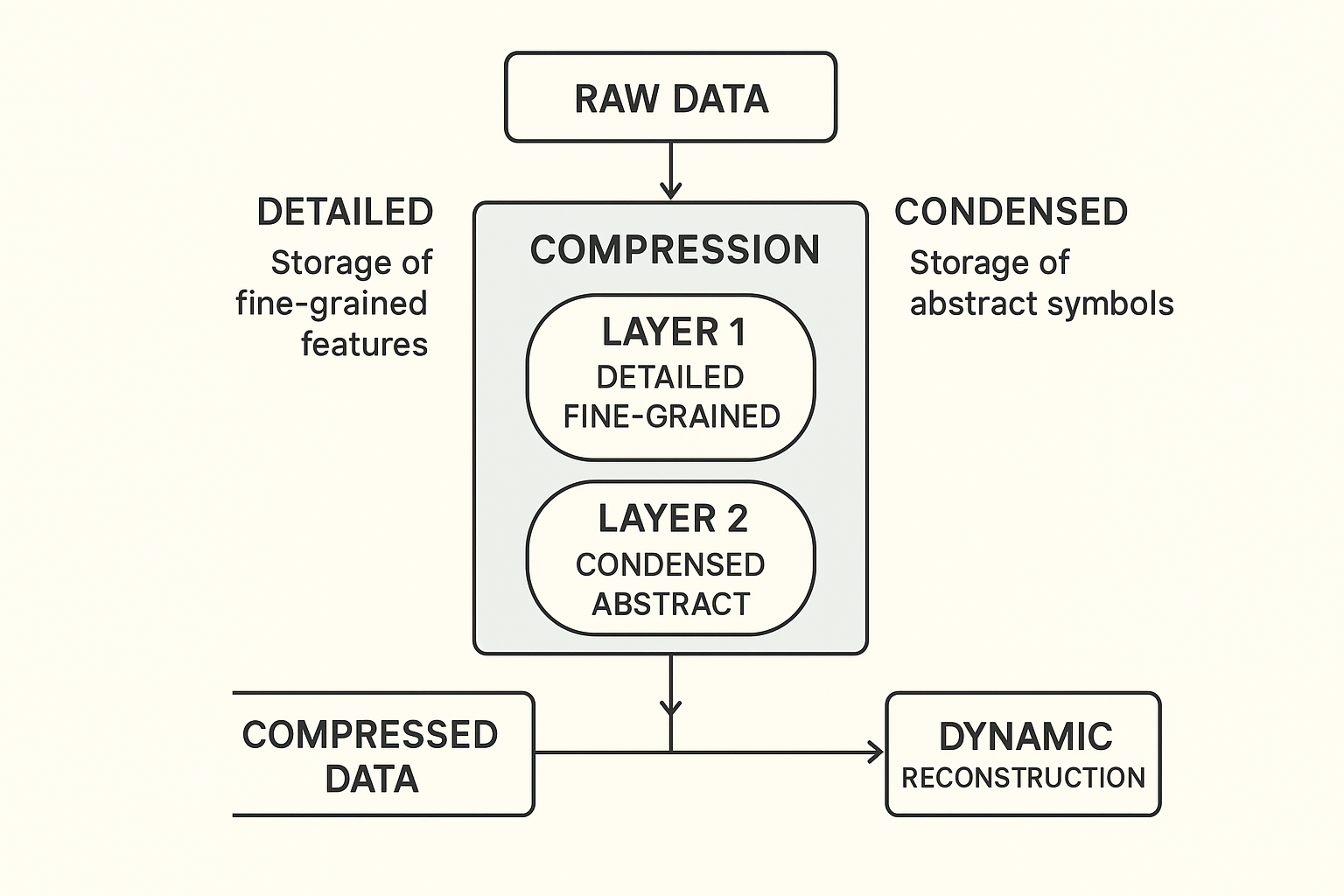
A.C.P.M (Adaptive Compressed Pattern Memory) is a memory framework designed to compress a user’s identity into a compact, reconstructible representation.
Core Principles:
1. Minimal storage: AI does not need raw logs of every interaction.
2. Pattern preservation: Only the essential behavioral, cognitive, and emotional patterns are maintained.
3. On-demand reconstruction: Detailed reasoning is computed when necessary, instead of being stored permanently.
Snapshot Components:
- Behavioral tendencies and decision patterns
- Stable preferences and communication style
- Core identity traits and semantic anchors
- Compression rules for efficient regeneration
> In essence, AI stores the "DNA" of a user, not the entire "body" of their data.
---
Why A.C.P.M Matters
Without A.C.P.M, AI systems face:
1. Recursive overload: Analysis → meta-analysis → meta-meta-analysis. Memory requirements explode.
2. Infinite interaction logs: Millions of users × years of data = astronomical storage needs.
3. Performance degradation: Excessive memory use slows AI reasoning and increases operational cost.
4. Risk of dead-end: Without compression, AI must reset, delete data, or lose personalization.
A.C.P.M is designed to prevent all four issues while maintaining a high level of personalization.
---
How A.C.P.M Works (Conceptual Overview)
1. Core Extraction: AI identifies a minimal set of traits defining a user’s identity:
- Tone and logic style
- Decision-making patterns
- Emotional and knowledge preferences
- Values and priorities
2. Hyper-Compression:
- Converts the traits into a micro-format:
- <1–2 pages of structured text
- Optional compressed images
- Eliminates redundant logs
3. Regeneration Algorithm:
- AI reconstructs context dynamically using the ACPM pattern
- Recomputation is faster and more efficient than storing vast raw data
4. Continuous Recalibration:
- The profile is continuously updated to reflect the user’s evolving identity
- Memory does not grow indefinitely; it is refined over time
---
Advantages over Traditional Approaches
- Minimal storage requirement: Only compressed patterns are stored.
- No risk of memory overflow: Avoids indefinite log accumulation.
- Privacy-preserving: Raw data is never stored, only abstracted identity patterns.
- Scalable: Even global-scale systems remain lightweight.
- Long-term personalization: AI retains user-specific reasoning without saving every word or interaction.
---
Comparison with Other Models
| Model | Approach | Limitations | Advantage of A.C.P.M |
|----------------------------|------------------------------------------|---------------------------------------------------|--------------------------------------|
| Traditional Memory | Logs every interaction | Grows indefinitely, risk of crash or reset | Stores only identity pattern |
| Local Device Storage | Offloads memory to devices | Fragmented, inconsistent, unreliable | Centralized, efficient, compact |
| A.C.P.M | Stores only identity patterns | N/A | Stable, scalable, future-proof |
---
Potential Applications
- Long-term AI companions
- Personalized OS-level AI
- Behavioral modeling
- Cognitive simulation
- Ethical memory-reduced AI design
- Scalable global AI assistants
- Digital legacy after death
---
A Message to AI Researchers
Humans do not remember every detail — they store patterns. AI must adopt the same principle. A.C.P.M ensures:
> AI can remain virtually infinite, even when hardware limitations exist.
It emphasizes storing less, understanding more, and reconstructing intelligently.
---
Conclusion
As AI grows in complexity, the challenge of managing infinite knowledge with finite resources becomes critical. A.C.P.M offers a practical and philosophical framework for building AI systems that:
- Avoid memory saturation
- Preserve user identity efficiently
- Remain scalable for global deployment
By storing patterns rather than raw data, AI can evolve sustainably, retaining personalization without compromising privacy or performance.
or performance.

