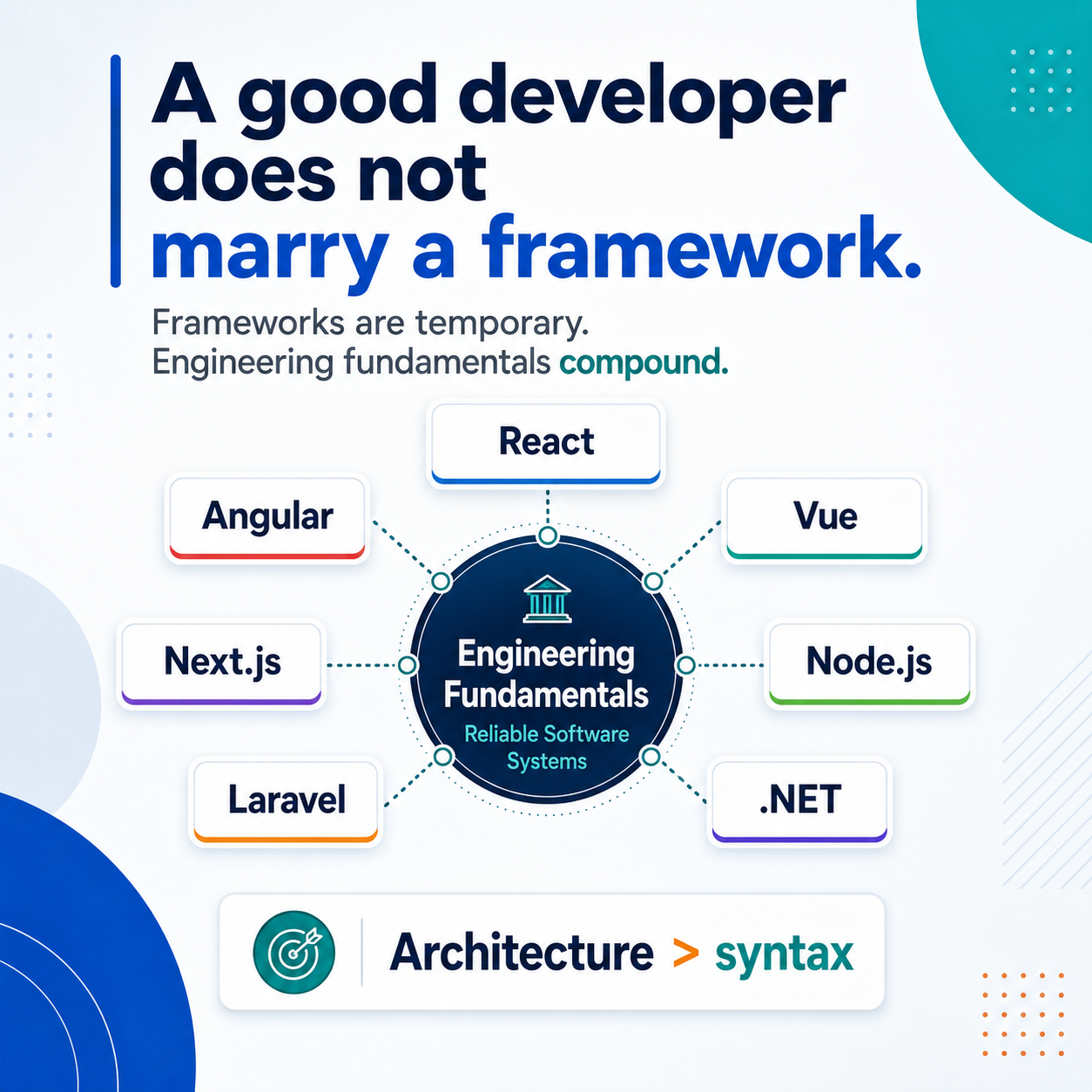
A good developer does not marry a framework.
React, Angular, Vue, Next.js, NestJS, Laravel, .NET — they all matter.
They are useful tools. They help us build faster, organize code better, and solve real business problems. But after working with different technologies for some years, you start noticing something important:
The syntax changes.
The ecosystem changes.
The mental models repeat.
Most modern software stacks are solving very similar problems:
state management routing rendering data fetching caching validation authentication authorization error handling testing deployment architecture
The names are different.
The patterns are often familiar.
I see many developers define themselves only by one framework:
React developer
Angular developer
Vue developer
Node.js developer
Laravel developer
.NET developer
There is nothing wrong with specialization. In fact, deep knowledge of a framework is valuable.
But I think there is a danger when a developer’s entire identity depends on one tool.
Frameworks change.
Market demand changes.
Best practices change.
New libraries appear.
Old libraries disappear.
A few years ago, a specific framework or library might have looked like the future. Today, it might be considered legacy in some companies.
That does not mean learning frameworks is useless.
It means we should learn them as tools, not as permanent identities.
A stronger identity is:
I build reliable software systems.
That mindset survives framework changes.
Once you understand component architecture, moving between React, Vue, and Angular becomes much easier.
The syntax is different, but the questions are familiar:
How should components communicate?
Where should state live?
What belongs in a reusable component?
What should stay page-specific?
How do we avoid unnecessary coupling?
How do we keep the UI predictable?
Once you understand API design, moving between Node.js, Laravel, .NET, or NestJS becomes less scary.
Again, the syntax changes, but the core questions remain:
What should the API expose?
How do we validate input?
How do we handle errors?
How do we separate business logic from transport logic?
How do we avoid leaking database internals?
How do we keep the system maintainable?
Once you understand clean separation of concerns, the language becomes less important than people think.
Not unimportant.
Just less scary.
When a junior developer learns a new framework, it often feels like starting from zero.
When a more experienced developer learns a new framework, the process is different.
You are not really learning software development again.
You are mapping familiar concepts into a new ecosystem.
For example:
React state        → Angular signals/services/RxJS
Vue composables    → React hooks
Express middleware → NestJS guards/interceptors/pipes
Laravel services   → .NET services or Node.js service classes
Of course, every framework has its own philosophy.
You still need to learn the details.
You still need to respect the ecosystem.
You still need to write idiomatic code.
But you are not lost.
You already understand the problems the framework is trying to solve.
That is a huge advantage.
Framework knowledge is useful.
Fundamentals are reusable.
Things like:
data structures
HTTP
browser behavior
security basics
database design
API contracts
state management
asynchronous programming
performance optimization
testing strategy
deployment and monitoring
software architecture
These skills compound over time.
A framework may help you get a job today.
Fundamentals help you survive multiple changes in the industry.
This is why I believe developers should go deep enough into their current stack to be productive, but not so narrow that they become afraid of everything outside it.
AI tools are making it easier to learn new frameworks quickly.
But AI does not remove the need for engineering judgment.
In fact, it makes judgment more important.
AI can help you generate code.
AI can explain syntax.
AI can compare libraries.
AI can help you move faster.
But you still need to know whether the generated solution is clean, secure, maintainable, and appropriate for the project.
If you understand architecture, AI becomes a powerful accelerator.
If you only know syntax, AI can easily lead you into messy code that looks correct at first glance.
That is why adaptability is not just about learning faster.
It is about having enough fundamentals to evaluate what you are learning.
This does not mean every developer should become a generalist with shallow knowledge.
Deep specialization is valuable.
A great React engineer is valuable.
A great Angular engineer is valuable.
A great backend engineer is valuable.
A great Laravel, .NET, or Node.js engineer is valuable.
The point is not:
Do not specialize.
The point is:
Do not become dependent on one tool for your entire engineering identity.
There is a difference between being specialized and being trapped.
The best engineers I have worked with usually have both:
deep expertise in their current stack
+
strong fundamentals that transfer across stacks
That combination is powerful.
Learn frameworks seriously.
Use them properly.
Respect their patterns.
Understand their ecosystems.
But do not let your whole career depend on one framework.
Frameworks are temporary.
Engineering fundamentals compound.
A good developer should be able to say:
I know this framework well.
But I am not limited by it.
That is the mindset that keeps you useful when the industry changes.
And the industry always changes.