AI can help us write code faster.
A lot faster.
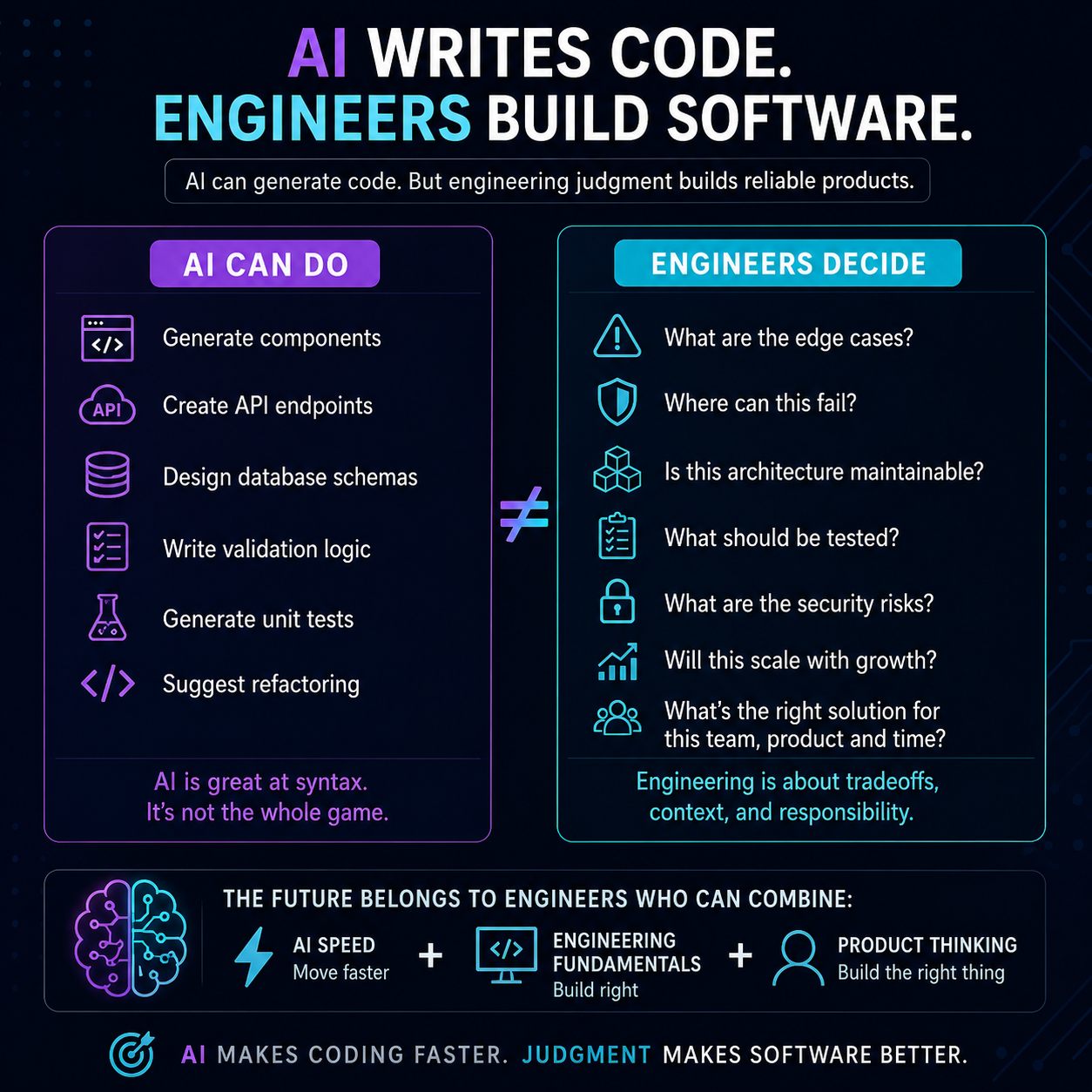
It can generate React components, create API endpoints, suggest database schemas, write validation logic, generate unit tests, explain errors, and even refactor messy code.
That is powerful.
But writing code is not the same as building software.
There is a big difference between:
Can this code run?
and:
Should this solution exist in this form?
That second question is where engineering judgment matters.
Modern AI tools are excellent at producing code.
You can ask for a component, a function, a service, a SQL query, a form validator, or a test case, and you will often get something useful in seconds.
For many daily development tasks, AI can remove a lot of friction.
It can help with:
boilerplate
syntax
quick examples
refactoring ideas
debugging hints
test generation
documentation
code explanation
library comparisons
This is why I believe developers should use AI.
Ignoring it completely is not a good strategy.
But there is a trap.
Because AI can generate something that looks correct, it is easy to confuse speed with quality.
Fast code is not always good software.
Software engineering is about tradeoffs.
It is about context.
It is about understanding the product, the team, the user, the deadline, the risks, and the future cost of today’s decisions.
AI can generate an API endpoint.
But the engineer still needs to ask:
Should this endpoint exist?
Who is allowed to call it?
What should happen on invalid input?
What should the response shape be?
Should this be cached?
How will we version it later?
What happens if the database is slow?
What should be logged?
What should not be exposed?
AI can generate a React component.
But the engineer still needs to ask:
Should this state be local or global?
Is this component doing too much?
Is this reusable or page-specific?
Will this re-render too often?
Is this accessible?
Is this easy for another developer to maintain?
AI can generate a database schema.
But the engineer still needs to ask:
Does this model reflect the real business rules?
Will this scale?
What should be indexed?
What should be normalized?
What should not be stored?
How will migrations be handled?
What happens when requirements change?
These questions are not just syntax questions.
They are engineering questions.
A junior developer may ask AI:
Build this feature for me.
A more experienced developer asks:
What are the edge cases?
Where can this fail?
What are the tradeoffs?
Is there a simpler solution?
What should be tested?
What are the security risks?
How will this behave under load?
How will another developer understand this later?
The difference is not only experience.
The difference is the quality of the questions.
AI is most useful when the developer already understands the problem well enough to guide it.
Without that, AI can produce code that looks polished but hides bad assumptions.
One of the biggest risks with AI-generated code is that it often sounds confident.
The code may be formatted well.
The explanation may sound reasonable.
The names may look clean.
But the solution may still be wrong for your actual project.
It may ignore edge cases.
It may introduce security issues.
It may use outdated patterns.
It may over-engineer a simple feature.
It may create abstractions that make the code harder to maintain.
It may solve the wrong problem beautifully.
That last one is dangerous.
A clean implementation of the wrong idea is still the wrong idea.
Some people say AI will make programming fundamentals less important.
I think the opposite.
AI makes fundamentals more important.
When AI can generate code quickly, the valuable skill becomes knowing whether that code is good.
To judge that, you need fundamentals:
HTTP
state management
database design
security basics
asynchronous programming
system design
testing strategy
performance
error handling
architecture
maintainability
Without fundamentals, you may accept whatever AI gives you.
With fundamentals, AI becomes an accelerator.
You can use it to move faster while still keeping control over quality.
Before AI, writing bad code took time.
Now bad code can be generated very quickly.
That means AI can help good engineers move faster, but it can also help weak engineering decisions spread faster.
The output speed increased.
The need for review did not disappear.
In fact, review became more important.
Every AI-assisted solution still needs to be checked against the actual context of the project:
Does this match our architecture?
Does this fit our coding style?
Does this introduce hidden coupling?
Is this secure?
Is this testable?
Is this simple enough?
Is this the right level of abstraction?
If we skip those questions, AI does not remove technical debt.
It accelerates it.
I do not like using AI as a blind code generator.
I prefer using it as a technical assistant.
For example:
Give me three possible approaches.
Compare the tradeoffs.
Show me the simplest version first.
Find edge cases.
Review this code.
Suggest tests.
Explain the performance risks.
Make this easier to maintain.
This kind of workflow keeps the engineer in control.
The developer provides direction.
AI provides speed.
The developer makes the final decision.
That is the right balance.
Good software is not only technically correct.
It also needs to solve the right problem.
AI may generate a beautiful implementation, but it does not always know the business context.
It may not know:
what the user actually needs
what the product goal is
what the deadline is
what the team can maintain
what the company can afford
what should be built now
what should be delayed
This is where product thinking matters.
Sometimes the best engineering decision is not the most advanced solution.
Sometimes the best solution is the simplest one that solves the real problem and keeps the product moving.
AI can help you build.
But you still need to decide what is worth building.
Use AI to move faster.
Do not use AI to stop thinking.
AI is great for:
speed
syntax
drafting
exploration
boilerplate
explanation
comparison
Engineers are still responsible for:
architecture
security
tradeoffs
maintainability
product fit
testing strategy
long-term consequences
The future does not belong to developers who ignore AI.
It also does not belong to developers who blindly trust AI.
The future belongs to engineers who can combine:
AI speed
+
engineering fundamentals
+
product thinking
AI makes coding faster.
Judgment makes software better.