Most developers think WebRTC video quality is only about internet speed.
But in real-time video apps, especially group calls, there is another important concept:
Simulcast.
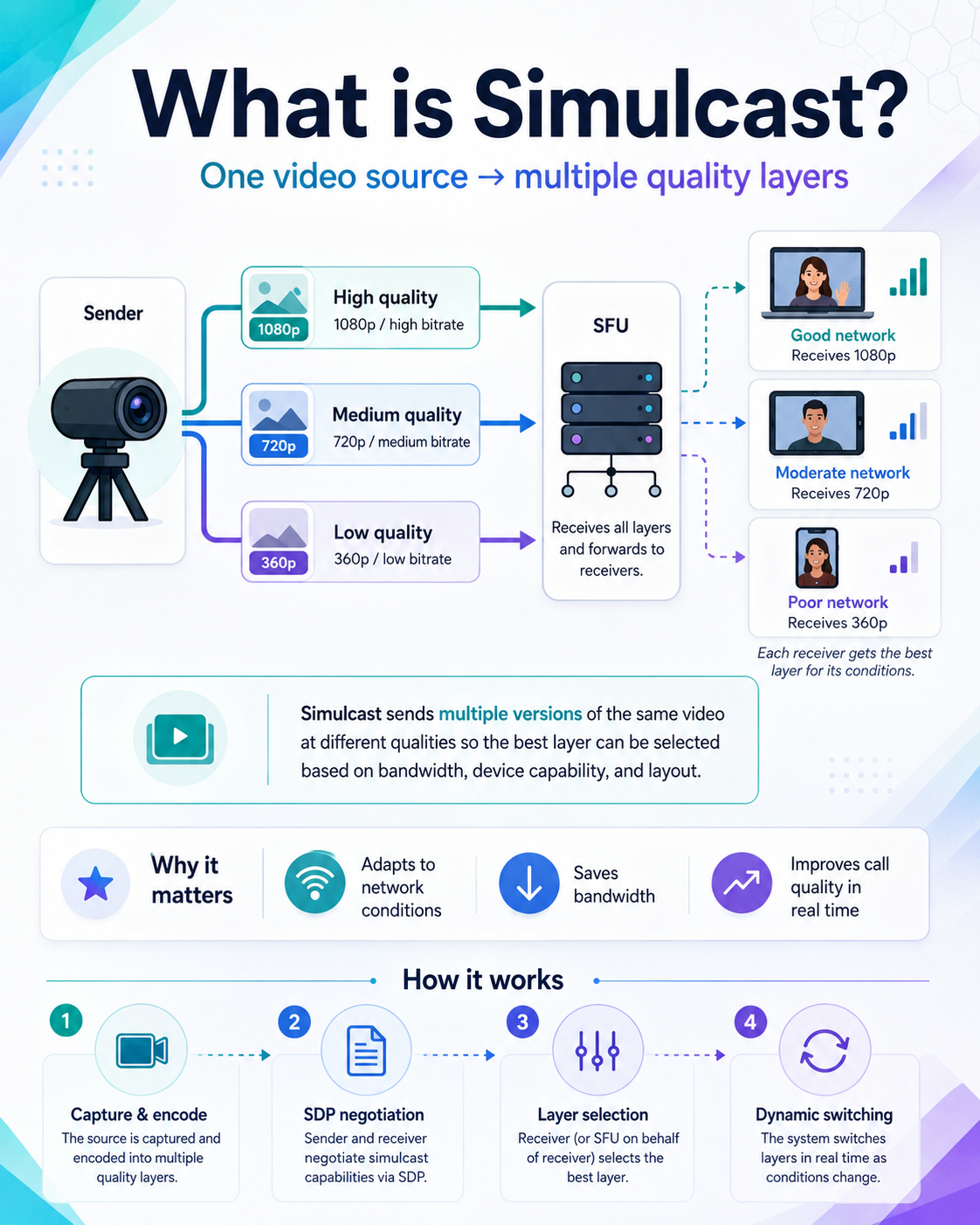
Instead of sending only one video stream, the sender can send multiple versions of the same video at different qualities.
For example:
Low quality → for weak networks / small thumbnails Medium → for normal participants High quality → for active speaker / large view
Then the receiver, SFU, or media server can choose the best layer depending on:
available bandwidth
device performance
screen size
active speaker layout
network changes
number of participants
This is why in many video call apps, one person can appear in high quality when pinned, but lower quality when shown as a small thumbnail.
The smart part is not just encoding video.
The smart part is sending the right quality to the right user at the right time.
Without this, large WebRTC rooms become expensive, unstable, and bandwidth-heavy very quickly.
My simple explanation:
Simulcast helps WebRTC apps avoid wasting bandwidth by sending multiple video layers and letting the system pick the most useful one.
This is one of those concepts that separates a basic video call demo from a production-grade real-time communication system.
Have you worked with WebRTC, mediasoup, Janus, Jitsi, or any SFU-based video system before?
#WebRTC #JavaScript #FrontendDevelopment #RealTimeCommunication #SoftwareEngineering #VideoStreaming #NodeJS #WebDevelopment