
LeetCode 75
1431. Kids With the Greatest Number of Candies
There are n kids with candies. You are given an integer array candies, where each candies[i] represents the number of candies the ith kid has, and an integer extraCandies, denoting the number of extra candies that you have.
Return a boolean array result of length n, where result[i] is true if, after giving the ith kid all the extraCandies, they will have the greatest number of candies among all the kids, or false otherwise.
Note that multiple kids can have the greatest number of candies.
Example 1:
Input: candies = [2,3,5,1,3], extraCandies = 3 Output: [true,true,true,false,true] Explanation: If you give all extraCandies to: - Kid 1, they will have 2 + 3 = 5 candies, which is the greatest among the kids. - Kid 2, they will have 3 + 3 = 6 candies, which is the greatest among the kids. - Kid 3, they will have 5 + 3 = 8 candies, which is the greatest among the kids. - Kid 4, they will have 1 + 3 = 4 candies, which is not the greatest among the kids. - Kid 5, they will have 3 + 3 = 6 candies, which is the greatest among the kids.
Example 2:
Input: candies = [4,2,1,1,2], extraCandies = 1
Output: [true,false,false,false,false]
Explanation: There is only 1 extra candy.
Kid 1 will always have the greatest number of candies, even if a different kid is given the extra candy.
Example 3:
Input: candies = [12,1,12], extraCandies = 10
Output: [true,false,true]
Constraints:
n == candies.length2 <= n <= 1001 <= candies[i] <= 1001 <= extraCandies <= 50برای حل این مسئله، باید بررسی کنیم که اگر به هر بچه تمام آبنباتهای اضافی رو بدیم، آیا اون بچه میتونه بیشترین تعداد آبنبات رو بین همه داشته باشه یا نه.
[2,3,5,1,3] مقدار ماکسیمم 5 هست.candies[i] + extraCandies >= max_candies باشه، یعنی اون بچه میتونه جزء بیشترینها بشه و مقدار True میگیره.False برمیگردونیم.کد پایتون (با کلاس Solution)
class Solution:
def kidsWithCandies(self, candies: list[int], extraCandies: int) -> list[bool]:
max_candies = max(candies)
return [candy + extraCandies >= max_candies for candy in candies]
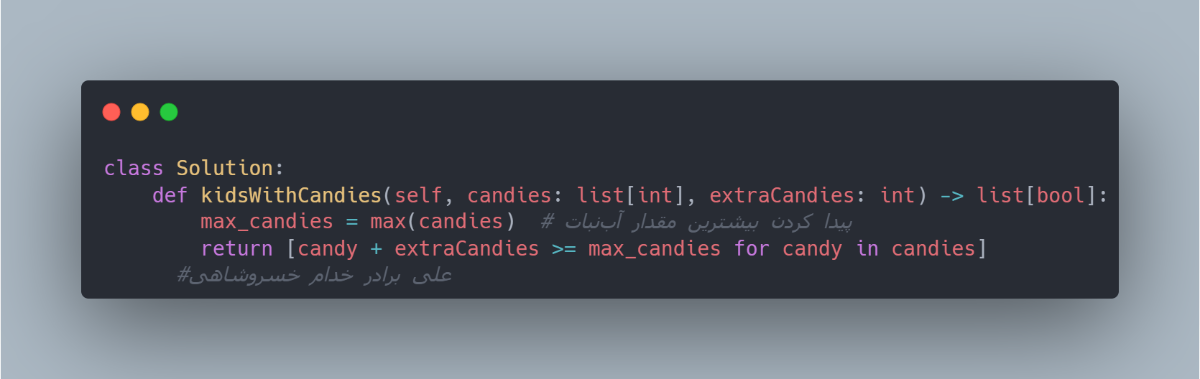
candies رو ذخیره میکنیم (max_candies = max(candies)).candy بررسی کنه:اگر candy + extraCandies >= max_candies بود، مقدار True میگیره.False.✅ سریع اجرا میشه (O(n)):
max زمان O(n) میبره.O(n) هست.O(n) + O(n) = O(n) که خیلی سریعه.✅ خوانا و تمیزه
✅ بهینه و بدون نیاز به لیست اضافی
حالا میتونی اینو روی مثالهای دیگه امتحان کنی! 🚀😊
علی برادر خدام خسروشاهی

