

When it comes to proving your English proficiency on an international scale, the IELTS exam is one of the most widely recognized benchmarks. For students, professionals, and immigrants alike, IELTS can open doors to universities, career opportunities, and new lives abroad. Yet behind every successful IELTS result lies one undeniable truth: Vocabulary is power.
Two essential books have been guiding candidates on this journey for years: IELTS Vocabulary up to band 6.0 and IELTS Vocabulary for bands 6.5 and above. These titles are not just books; they represent different stages of growth in the English learning process. Together, they cover the bridge between intermediate learners striving for a solid band score and advanced candidates aiming for academic excellence.
This reportage explores how these books shape the learning experience, what makes them unique, and why English words remains at the heart of every IELTS success story.
English Vocabulary: The Core of IELTS Success
In every IELTS exam—Listening, Reading, Writing, or Speaking—Vocabulary plays a decisive role. Examiners assess lexical resource, a measure of how varied and precise your English Vocabulary is. An average student with limited Vocabulary might understand a passage but fail to express answers clearly. Conversely, a student with strong Vocabulary can demonstrate fluency, nuance, and accuracy.
Teachers, examiners, and language researchers agree: without Vocabulary, English is like a body without bones. You cannot construct meaning or move fluidly through the exam tasks.
It is in this gap—between needing words and mastering them—that IELTS Vocabulary up to band 6.0 and IELTS Vocabulary for bands 6.5 and above have earned their reputation.
IELTS Vocabulary up to band 6.0: Building the Foundations

For many learners, the first step is achieving a respectable score, typically around 5.5 to 6.0. Universities, immigration offices, and workplaces often require at least this band as proof of functional English. But reaching this level demands more than basic grammar and simple words—it requires systematic Vocabulary building.
That is where IELTS Vocabulary up to band 6.0 comes in. This book focuses on essential English Vocabulary that appears frequently across IELTS topics such as family, work, education, travel, and daily life.
What makes the book effective?
Structured Themes: Each unit introduces words within real-life IELTS contexts. Instead of memorizing random lists, students connect Vocabulary to actual tasks.
Practical Exercises: Learners engage in gap-fills, synonym matching, and short writing prompts that mirror IELTS exam demands.
Focus on Common Errors: Many English learners confuse similar words. The book clarifies these pitfalls, helping students avoid costly mistakes.
As one student in Tehran put it, “IELTS Vocabulary up to band 6.0 was the first book that made me feel comfortable expressing myself in English. Before, I always repeated the same words. Now I can explain more ideas.”
For English learners in this stage, Vocabulary is not just about passing the test—it is about gaining the confidence to communicate.
IELTS Vocabulary for bands 6.5 and above: Reaching Academic Precision
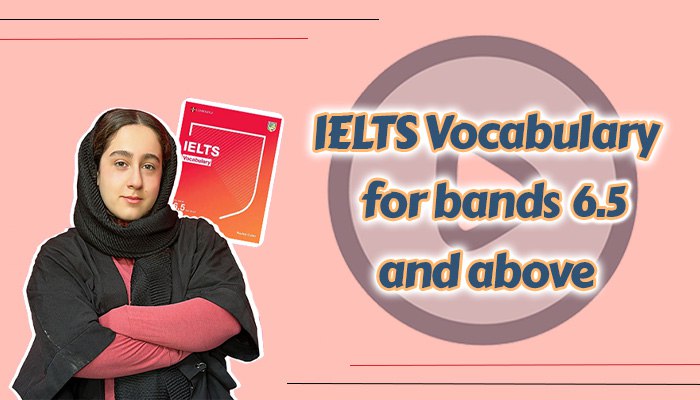
Once a student has secured a foundation, the next challenge is moving beyond general English to academic and professional use. Universities and employers often set the bar at band 6.5 or higher, meaning candidates must demonstrate not only accuracy but also sophistication in their English Vocabulary.
IELTS Vocabulary for bands 6.5 and above addresses this need directly. The book introduces advanced words and expressions grouped into high-level IELTS topics: environment, globalization, technology, culture, economics, and health. These are the themes that dominate academic reading passages, essay questions, and speaking tasks.
Key strengths of the book include:
Academic Register: It teaches learners how to shift from everyday English Vocabulary to formal, academic English suitable for essays and reports.
Collocations and Phrases: Instead of isolated words, students learn combinations like “economic downturn,” “technological advancement,” or “cultural heritage.”
Critical Thinking Exercises: Tasks encourage students to apply new Vocabulary in structured arguments—exactly what examiners want to see.
According to an IELTS trainer in London, “Many candidates plateau at band 6.0 because they lack advanced Vocabulary. With IELTS Vocabulary for bands 6.5 and above, students finally have the tools to write essays that sound like academic English, not casual conversation.”
A Tale of Two Books: Complementary Pathways
Although IELTS Vocabulary up to band 6.0 and IELTS Vocabulary for bands 6.5 and above target different levels, they are best understood as two halves of one journey.
For beginners and lower-intermediate learners, starting directly with advanced English Vocabulary can be overwhelming. The first book gives them a step-by-step foundation.
For intermediate learners aiming higher, the second book builds sophistication, precision, and academic readiness.
Used together, the two books ensure continuous growth, helping candidates move from simple English expressions to nuanced Vocabulary mastery.
In reportage style, we can hear the voices of students who used both. “At first, IELTS Vocabulary up to band 6.0 gave me the basics. But when I reached 6.0, I was stuck. Only after I switched to IELTS Vocabulary for bands 6.5 and above did I break through to 7.0,” says Farah, an English learner from Dubai.
Strategies for Mastering English Vocabulary with These Books
Books alone are not enough—how learners use them matters. Teachers recommend:
Active Note-Taking: Record new Vocabulary in a personal notebook with translations, synonyms, and example sentences.
Flashcards & Apps: Reinforce English Vocabulary daily with digital or paper flashcards.
Practice in Context: Use new words in IELTS-style essays or speaking tasks. For instance, if the word is “sustainable,” write a short paragraph about sustainable development.
Combine Skills: Read English newspapers, listen to podcasts, and highlight Vocabulary from the books in real materials.
Regular Revision: Vocabulary fades if not reviewed. Weekly revision ensures long-term retention.
These techniques, paired with IELTS Vocabulary up to band 6.0 and IELTS Vocabulary for bands 6.5 and above, guarantee faster progress.
Reportage Voices: Teachers and Learners
The strength of these Vocabulary books comes not only from their content but from the stories of those who use them.
Sarah, an IELTS instructor in Canada: “My students who use IELTS Vocabulary up to band 6.0 are better prepared for everyday English communication. But those who push further with IELTS Vocabulary for bands 6.5 and above achieve the academic language universities demand.”
Jin, a student in Seoul: “At first, I thought Vocabulary meant memorizing lists. These books showed me that English Vocabulary is about context. Now I can write essays about global issues using precise words.”
Ahmed, an immigrant in Australia: “Vocabulary was always my weakness. I used IELTS Vocabulary up to band 6.0 to pass the immigration requirement, and later IELTS Vocabulary for bands 6.5 and above to prepare for my nursing studies.”
These testimonies illustrate how English Vocabulary, supported by the right resources, transforms lives.
The Bigger Picture: Why Vocabulary is the Heart of English Learning
Grammar tells us how to build sentences, but Vocabulary provides the building blocks. Without enough words, English learners remain stuck, unable to express complex ideas. IELTS recognizes this, which is why Vocabulary accounts for 25% of the score in Writing and Speaking.
Both IELTS Vocabulary up to band 6.0 and IELTS Vocabulary for bands 6.5 and above respond directly to this demand. They do not promise shortcuts but instead offer systematic, practical ways to expand Vocabulary in line with IELTS expectations.
For English learners, investing time in these books is investing in their future.
Danesh Land: Video Lessons for IELTS Vocabulary Books
While books are powerful, many English learners benefit even more from guided explanations and real examples. At Danesh Land, both IELTS Vocabulary up to band 6.0 and IELTS Vocabulary for bands 6.5 and above are available as complete video lessons.
These video courses break down every unit of the books, explain difficult English Vocabulary in simple ways, and show learners how to apply words in speaking and writing tasks. Instead of studying alone, students feel as if a teacher is walking them through the process step by step.

Many learners have reported that combining the books with the Danesh Land video lessons accelerated their progress. As one student shared: “Reading IELTS Vocabulary up to band 6.0 was useful, but when I watched the video lessons on Danesh Land, I finally understood how to use the words in real IELTS Speaking answers.”
By blending the structure of the books with the interactive teaching style of Danesh Land, learners gain the best of both worlds: strong English Vocabulary knowledge and the confidence to apply it in every IELTS task.
Conclusion: From 6.0 to 6.5 and Beyond
In the end, IELTS success is not about luck—it is about preparation. English Vocabulary is the golden key, and these two books are among the most trusted tools for unlocking it.
IELTS Vocabulary up to band 6.0 provides the essential foundation every learner needs.
IELTS Vocabulary for bands 6.5 and above equips candidates with advanced, academic Vocabulary to achieve higher scores.
Together, they tell a story of progress: from simple communication to sophisticated expression, from intermediate English to academic mastery.
As one examiner remarked, “When candidates use rich Vocabulary, their English shines. These books help them shine brighter.”
For every learner chasing IELTS dreams, the message is clear: master your Vocabulary, and you master your future.

