
February 9, 2025
IRIS Kharg has been the backbone of the Iranian navy’s anti-piracy missions in the Arabian Sea and the Gulf of Aden since 2009 before her accidental sinking. Kharg, a modified Ol-class fleet replenishment oiler built by Swan Hunter in the United Kingdom, was delivered to Iran in 1984. Typically, Iran deploys one Alvand-class frigate for such missions, with Kharg providing logistical support by carrying 22,000 tonnes of supplies, enabling missions to last between 70 to 90 days.
The sinking of Kharg in 2021, Iran’s proxy war in Yemen, and the volatile situation in the Gulf of Aden have compelled the Iranian navy to seek solutions for longer missions and to support their allies in Yemen. Given the lack of a permanent naval base in the region and the limitations of their existing logistic ships, the Iranian navy decided to create an expeditionary mobile base. To achieve this, they purchased a second-hand oil tanker and converted it into a mobile base, defining a new class of logistic ships called "port-ship" by the Iranian Navy, and naming it IRINS Makran.
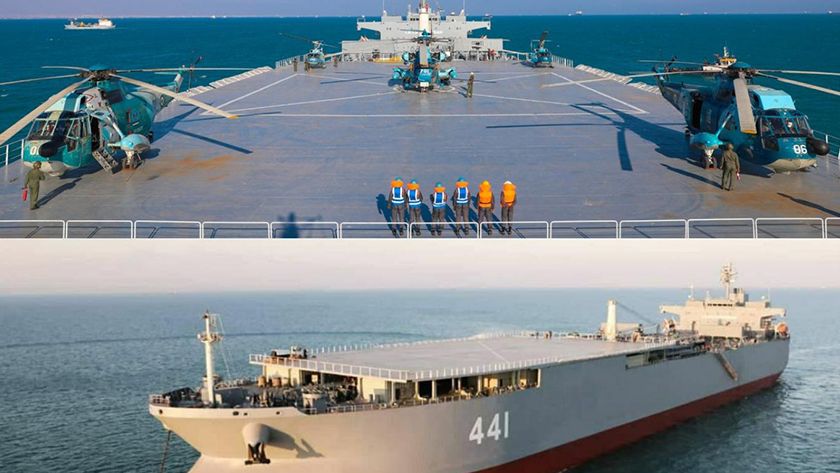
Makran, originally a Betta-class oil tanker (registered as IMO 9486910), is now one of the largest vessels in the Iranian navy. The conversion began in June 2020 at the Shahid Darvishy shipyard in Bandar Abbas, and after six months, it was officially commissioned on January 13, 2021. The ship was outfitted with a large helipad, transforming into a landing helicopter platform. Iranian officials claim that Makran is capable of performing a variety of missions, including:
Additionally, Makran is equipped to perform logistical support, search and rescue missions, special forces deployment, replenishment and transfer of supplies, medical assistance, and serve as a base for fast attack boats.
Makran has two containerized missile launch platforms, six defensive gun positions, and various electronic warfare systems, making it a suitable asset in modern naval warfare. It is also outfitted with advanced data collection systems, enabling it to perform intelligence-gathering missions, process and analyze data, and relay information to command centers onshore.
The ship’s primary anti-ship missile options include the Qadir (with a range of 300 km) and the Abu-Mahdi (with a range exceeding 1,000 km). Additionally, Makran carries four speedboats capable of transporting 12 personnel each, equipped with 107mm rocket launchers, and 15 SDVs (Swimmer Delivery Vehicles) for special operations.
Makran’s UAV capabilities are also noteworthy. The Pelican UAV, with a range of 1,200 km and equipped with electro-optical systems, can perform reconnaissance, targeting, and surveillance operations around the ship. This makes Makran a versatile platform for both offensive and defensive missions.
Makran’s size and capabilities make it a significant addition to the Iranian navy. At 755 feet long, it is substantially larger than the Shahid Roudaki, another converted logistics ship in the Iranian fleet, and comparable in size to the U.S. Navy’s Expeditionary Mobile Bases (ESBs). While Makran lacks the auxiliary deck near the waterline found on ESBs, which limits its flexibility in loading and unloading supplies, it still offers a robust platform for a variety of missions.
Iranian media reports suggest that Makran can carry six to seven helicopters, including RH-53D Sea Stallions, SH-3D Sea Kings, and AB212ASW helicopters. The ship’s large flight deck and open space allow the installation of additional weapon systems, such as mobile surface-to-air missile systems and associated radars. However, the lack of integrated air defense systems leaves the ship as a sitting dock to aerial threats, a significant drawback given its size and strategic role.
While Iran has made bold claims about Makran's capabilities, some remain uncertain. Its exact configuration and ease of transitioning between roles are unclear. However, it likely shares some mission profiles with US Navy ESBs, including:
Makran could also serve as a "mother ship" for clandestine operations, similar to the MV Saviz, supporting proxies and potentially challenging regional rivals. It could facilitate covert attacks, mine laying, and special operations.
Makran’s design and capabilities draw comparisons to the U.S. Navy’s ESBs, which are also converted oil tankers. However, Makran lacks some of the advanced features of ESBs, such as the ability to operate V-22 Ospreys and AH-64E Apache helicopters. The Iranian Navy doesn't have any attack helicopter or VSTOL warplane like the F-35. Meanwhile, it lacks the ESBs' well deck for easier loading and unloading, potentially limiting its flexibility. Despite these limitations, Makran represents a significant step forward for the Iranian navy, providing a versatile platform for extended missions in the Gulf of Aden, the Red Sea, and beyond.
While IRINS Makran represents a significant advancement for the Iranian navy, it is not without its limitations and disadvantages. These drawbacks could impact its operational effectiveness and strategic value. Below are some of the key disadvantages of Makran:
- Vulnerability to Aerial Threats: Makran lacks advanced integrated air defense systems, making it highly vulnerable to aerial attacks, including missiles and aircraft. Its large size and slow speed (14.4 knots) make it an easy target for modern anti-ship missiles and airstrikes.
- Dependence on External Support: Without robust air defense capabilities, Makran would rely heavily on escort ships or land-based air support for protection, limiting its operational independence. Currently, the Iranian Navy lacks sufficient escort ships to protect this ship.
- No Hangars: Makran does not have hangars for helicopters or UAVs, which means its aircraft are exposed to the elements and potential damage during operations. This limits the ship’s ability to maintain and deploy aircraft effectively over extended periods.
- Limited Helicopter Capacity: While Makran can carry up to five helicopters, this number is relatively small compared to the capabilities of modern expeditionary mobile bases, such as those operated by the U.S. Navy. Makran is not a helicopter carrier like HMS Ocean of the Royal Navy.
- Low Speed: With a maximum speed of 14.4 knots, Makran is relatively slow, making it difficult to evade threats or respond quickly to changing tactical situations.
- Limited Maneuverability: As a converted oil tanker, Makran’s design is not optimized for high-speed maneuvers, which could be a disadvantage in combat scenarios or when navigating congested waterways.
- Limited Flexibility: Unlike the U.S. Navy’s Expeditionary Mobile Bases (ESBs), Makran does not have an auxiliary deck near the waterline for loading and unloading supplies. This reduces its flexibility in supporting amphibious operations or transferring cargo in challenging conditions.
- Dependence on Cranes: Makran relies on deck cranes for handling boats and supplies, which can be slower and less efficient compared to dedicated loading systems. However, no crane is seen next to the main deck of the Makran. Installation of a crane on the deck was likely abandoned for reasons of helicopter flight safety.
- Limited Self-Sufficiency: While Makran can carry significant amounts of fuel and water, it still depends on external logistics to resupply other critical items, such as ammunition and spare parts. This could limit its endurance during extended missions.
- Vulnerable Supply Lines: In contested environments, Makran’s reliance on external supply chains could make it vulnerable to interdiction or disruption.
- Minimal Defensive Weapons: Makran’s defensive armament is relatively limited, with only a few gun positions and no advanced close-in weapon systems (CIWS) or missile defense systems. This leaves Makran exposed to attacks from fast attack craft, drones, or missiles.
- No Integrated Missile Defense: The ship lacks a comprehensive missile defense system, which could be a critical shortcoming given the prevalence of anti-ship missiles in modern naval warfare.
- Inexperienced Crew: Operating a ship as complex as Makran requires highly trained personnel. Iran’s navy may face challenges in adequately training its crew to handle the ship’s diverse missions, including aviation operations, electronic warfare, and special forces deployment.
- Limited Operational Experience: As a relatively new addition to the fleet, Makran’s crew may lack the operational experience needed to maximize its capabilities in high-stress environments.
- Geopolitical Constraints: Makran’s deployment in contested regions, such as the Gulf of Aden or the Red Sea, could escalate tensions with regional powers like Saudi Arabia or the United States. This limits its operational freedom and increases the risk of confrontation.
- Limited Role in High-Intensity Conflicts: While Makran is well-suited for low-intensity operations (e.g., anti-piracy, humanitarian missions), it may struggle in high-intensity conflicts against advanced naval forces due to its vulnerabilities.
- High Maintenance Costs: As a converted oil tanker, Makran may require significant maintenance to keep its systems operational, especially given the harsh conditions of prolonged deployments.
- Sustainability Challenges: The ship’s ability to sustain long-term operations without frequent resupply and maintenance could be a concern, particularly in remote or hostile environments.
- Propaganda vs. Reality: Iranian officials have made bold claims about Makran’s capabilities, including its ability to carry ballistic and cruise missiles. However, the actual implementation of these features remains unclear, and some capabilities may be exaggerated for propaganda purposes.
- Limited Combat Provenance: Unlike U.S. or NATO expeditionary bases, Makran has not been tested in real combat scenarios, raising questions about its performance under fire.
Iran has already begun work on a second ship of this class, Makran 2, including improved hospital facilities, advanced elevators for moving helicopters between decks, and additional space for special operations teams. These upgrades will further solidify Makran’s role as a key asset in Iran’s naval strategy.
While IRINS Makran represents a significant step forward for the Iranian navy, its disadvantages—such as vulnerability to aerial threats, limited defensive armament, and dependence on external logistics—could hinder its effectiveness in high-intensity operations. Its role as an expeditionary mobile base is promising, but its limitations highlight the challenges Iran faces in projecting naval power beyond its immediate region. Whether it functions as a versatile expeditionary mobile base or primarily as a floating gas station remains to be seen.

