
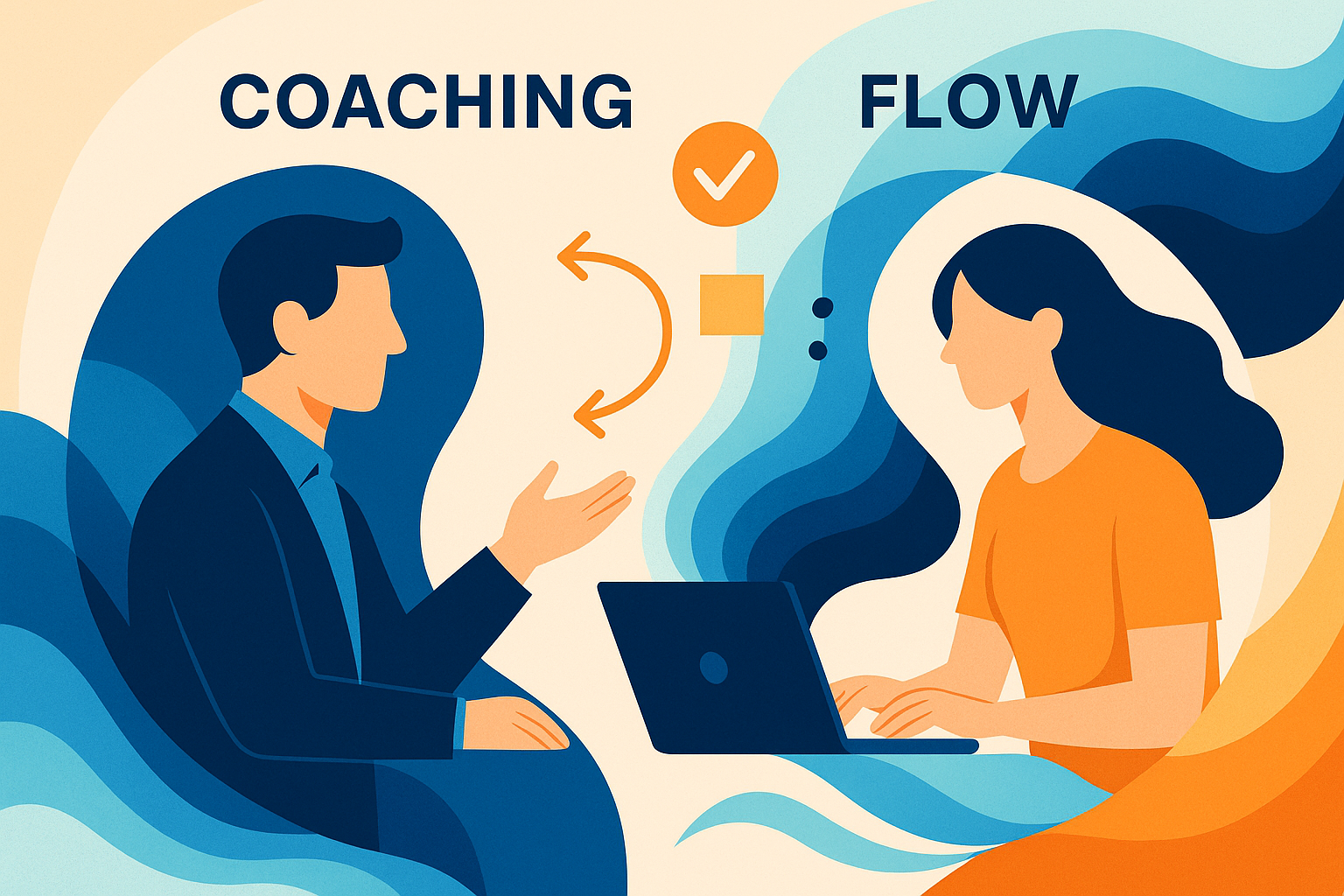
Flow, first introduced by Mihaly Csikszentmihalyi of the University of Chicago, refers to a state of complete mental absorption in an activity, where attention, enjoyment and performance reach their peak. Coaching, especially in personal development and life coaching, plays a significant role in helping clients enter and maintain this state. This article examines the relationship between coaching and Flow, based on evidence from positive psychology and established scientific theories.
Csikszentmihalyi describes Flow as a state of deep mental immersion. During this state:
The perception of time becomes distorted
Concentration becomes laser-focused
Motivation comes from within rather than from external pressure
Skill and challenge reach a balanced point
Attention anchors fully in the present moment
Flow usually occurs when the level of challenge is slightly above the level of one’s skills. Similar to a game that is not too easy to get boring and not too hard to create anxiety.
This state is not only enjoyable but also enhances learning, creativity, performance and overall life satisfaction.
Coaching is a structured and collaborative process that helps clients:
Gain clarity
Define their goals
Identify internal obstacles
Build new skills
And most importantly, experience growth rather than endure it
In essence, coaching helps individuals access a higher version of themselves and build a clear path toward stable focus, motivation and action.
Both coaching and Flow revolve around a central idea: activating inner abilities and transforming pressure into growth.
To enter Flow, individuals must know exactly what they are doing.
Coaching creates this clarity by removing ambiguity and sharpening focus.
Flow occurs where challenge slightly exceeds skill.
Coaching intentionally designs this zone:
challenging enough to stimulate growth, but safe enough to avoid overwhelm.
Flow thrives on immediate feedback.
Through skillful questioning, exercises and reflective listening, coaching provides the feedback loop the brain needs to stay engaged.
Knowing why an action matters triggers intrinsic motivation, which is the strongest doorway into Flow.
Coaching helps clients:
Break goals into smaller steps
Create short-term milestones
Identify an accessible starting point
This shifts the mind from confusion to focus.
By exploring limiting beliefs, fears, procrastination and perfectionism, coaching reduces cognitive noise.
Flow can only occur in a mentally free and open space.
Coaches often use practices such as:
Focused breathing
Setting a pre-task intention
Establishing a consistent routine
Flow lives in the now, and these practices open the door to it.
The brain accelerates performance when it feels improvement.
Coaches reinforce this sense through structured feedback and reflective questions.
Interestingly, Flow benefits not only the client but also the coach.
A coach in Flow:
Listens more deeply
Asks intuitive and powerful questions
Experiences heightened awareness
Guides the session more naturally without pressure
This is where the session is not merely managed but truly lived.
The client selects a task that is 10% more difficult than their current skill level.
This creates the ideal zone for Flow.
Before starting a session or task:
2 minutes of conscious breathing
Writing the main intention
Setting a small challenge
These steps create a mental tunnel into Flow.
Break any project into 15-minute blocks.
Flow often emerges between minutes 7 and 12.
Coaching and Flow have a direct, dynamic and mutually reinforcing relationship.
Coaching prepares the mind for focus, clarity and emotional ease.
Flow amplifies learning, performance and growth.
When both the coach and the client enter a Flow state, the session becomes more than a conversation.
It becomes an experiential journey, where growth is not only achieved but deeply felt.

